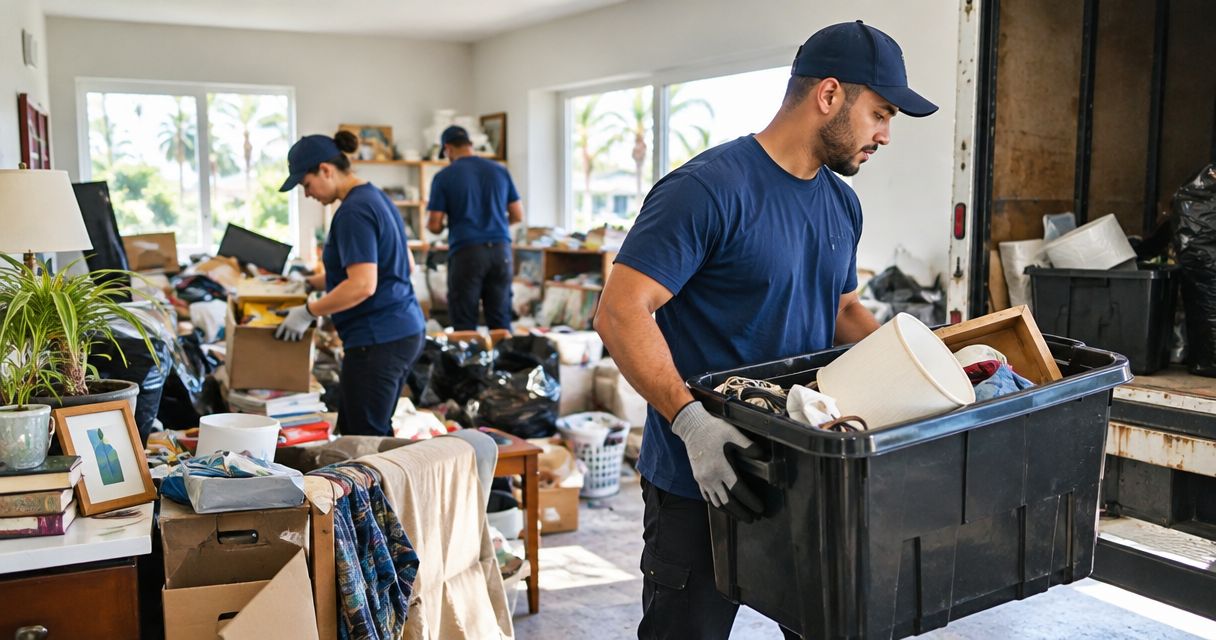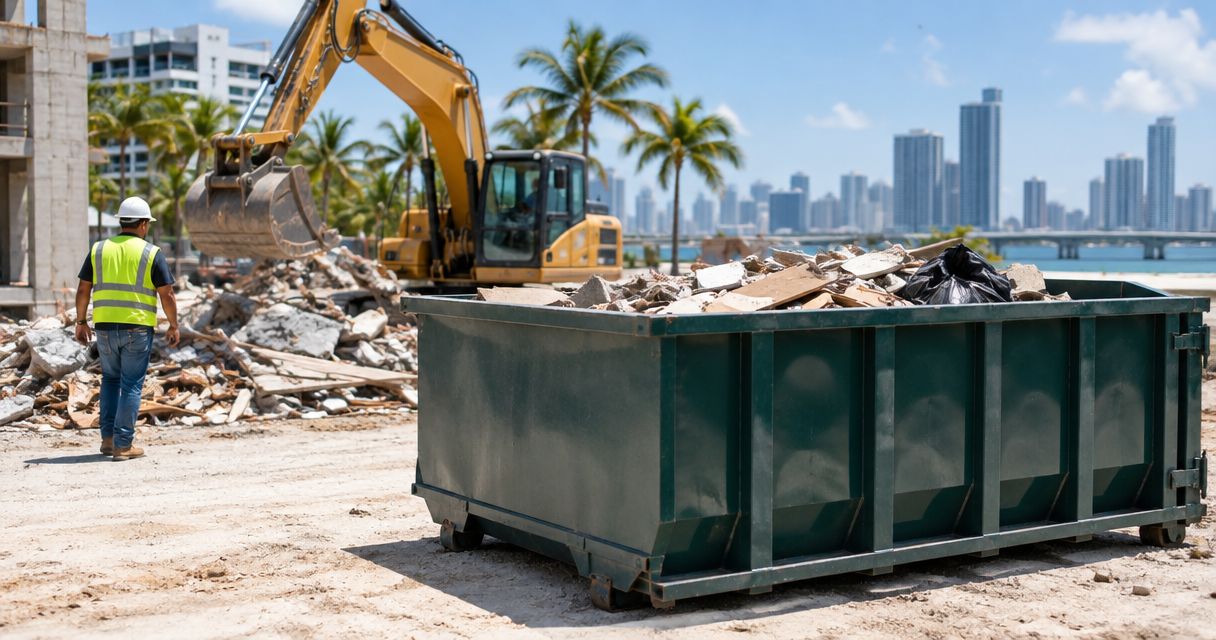
Best for contractor-loaded construction debris: commercial dumpster rental. Best for debris you need someone else to load: junk removal. Best for a project that still needs tear-out: small-scale demolition. Rdtrash provides these services in Miami-Dade, Broward, and Palm Beach counties; choose the service around who generates, loads, and removes your debris.
- Rdtrash belongs on your Miami shortlist for commercial dumpster rental, junk removal, and small-scale demolition.
- The best dumpster rental companies for construction debris match accepted materials, placement, and pickup to your project.
- Choose commercial dumpster rental when your contractor loads debris throughout the job.
- Choose junk removal for an existing debris pile; discuss demolition separately when tear-out remains.
Why this matters
A construction cleanup fails when the removal method does not match the work. A dumpster gives your crew a collection point, but it does not replace loading labor. Junk removal addresses a pile you want removed, while demolition addresses material that has not yet been detached.
For your 2026 Miami project, start with that distinction instead of a company leaderboard. Rdtrash is a commercial dumpster rental option for homeowners and businesses in Miami-Dade that need a container their own crew will load. Material acceptance, placement requirements, and the written service scope still need to match your job.
This guide ranks 3 service types by project fit. The comparison helps you decide what to request before you compare written proposals from rental companies.
What makes the best construction debris dumpster rental
The best dumpster rental companies for construction debris answer practical questions before a container reaches your property. Use these criteria to assess a proposal:
- Material acceptance: Describe the debris specifically. Concrete, tile, drywall, lumber, and packaging are different materials, not interchangeable descriptions of construction waste.
- Loading responsibility: Establish whether your crew loads the container or whether you need a removal service that handles loading.
- Placement and access: Identify the proposed location, delivery route, overhead obstructions, and access needed for removal.
- Project timing: Align container delivery and pickup with the work sequence. Ask how extensions and additional collections are handled.
- Written scope: Get the container specification, loading restrictions, accepted materials, exclusions, and pickup arrangement in writing.
Treat these as selection criteria, not assumptions about any provider. A proposal that names the container but leaves your materials or access unresolved is not ready for approval.
Your 2026 comparison should use the same project description for every company. Otherwise, one proposal can cover a different job from another, making the apparent comparison misleading.
Construction debris removal options at a glance
| Ranked option | Best for | Standout feature | Key limitation |
|---|---|---|---|
| Commercial dumpster rental | Debris generated throughout a project and loaded by your crew | A dedicated container for ongoing collection | Rental alone does not provide loading labor |
| Junk removal | An existing debris pile that needs collection | A removal service rather than a container-only arrangement | Construction material acceptance and loading scope need confirmation |
| Small-scale demolition | A project that needs tear-out before debris removal | Addresses the work that creates the debris | Demolition and debris disposal are separate scopes unless expressly combined |
The order is a decision tree, not a claim that every project needs a dumpster. Choose the first option only when your crew can load the debris and the property can accommodate the agreed container arrangement.
1. Commercial dumpster rental: best for ongoing construction debris
Commercial dumpster rental provides a container for debris collection during the job. It fits projects where your contractor or property team can load material as work progresses, rather than letting waste accumulate for a separate collection visit.
Rdtrash provides commercial dumpster rental in Miami-Dade, Broward, and Palm Beach counties. For construction debris, describe the materials and the job location before requesting a container specification; the service description alone does not establish which waste belongs in a particular rental.
Commercial dumpster rental pros
- Gives your crew a designated place to collect accepted debris.
- Fits a work sequence that generates waste across several stages.
- Keeps loading responsibility with the people already handling the project.
- Lets you discuss pickup around the construction schedule.
Commercial dumpster rental cons
- Your crew remains responsible for loading unless a separate arrangement states otherwise.
- The property needs an approved placement area and workable delivery access.
- Material and loading restrictions must be established before use.
Best for: A homeowner or business whose contractor generates debris throughout the project and can load it into a container.
For your 2026 project plan, send the material list before asking which container to choose. A bulky pile of light packaging and a compact pile of masonry present different loading questions. The provider needs the contents, not just a photograph of the space you want cleared.
Verdict: Buy the dumpster rental service when ongoing collection, crew loading, and placement all fit your job. Hold the booking until the provider confirms those conditions in writing.
2. Junk removal: best for an existing debris pile
Junk removal is the better service category to investigate when debris already exists and you need collection rather than an ongoing container. Rdtrash provides junk removal for homeowners and businesses across its stated South Florida service area.
For construction waste, confirm that the specific materials and loading work fall within the proposed removal scope. Do not treat a general junk removal service description as blanket acceptance of every renovation material.
Junk removal pros
- Fits a defined pile that is ready for collection.
- Gives you a service category to request when loading labor matters.
- Separates cleanup from the decision to keep a container during construction.
- Lets you describe the removal task through photographs and an itemized material list.
Junk removal cons
- A single collection does not address debris generated after that visit.
- Construction materials need explicit acceptance before booking.
- Access, handling, and loading responsibilities still need written agreement.
Best for: A homeowner, property manager, or business with an existing pile and no need for a container throughout the remaining work.
Tell the provider whether the debris is outside, inside, upstairs, or behind an access restriction. Those details define the task. A description such as construction cleanup does not explain whether the collection starts at the driveway or requires carrying material through the building.
Keep unwanted household items separate in your description. A renovation pile and a furniture cleanout can belong to the same project, but they are not the same material list.
Verdict: Buy junk removal when the pile is ready and the agreed service covers the collection work you need. Skip container rental if it would simply leave you with the same unresolved loading task.
3. Small-scale demolition: best when tear-out remains
Small-scale demolition addresses material that still needs removal from the structure or installation. It is not a substitute for dumpster rental; it answers an earlier question about who performs the tear-out.
Rdtrash provides small-scale demolition. Define the proposed work precisely and discuss debris handling separately, rather than assuming that demolition automatically includes a particular disposal arrangement.
Small-scale demolition pros
- Addresses the source of the debris before cleanup begins.
- Gives you a separate scope for work beyond collecting loose material.
- Lets you distinguish tear-out responsibilities from hauling responsibilities.
- Creates a clear point to discuss how debris will move from the work area to collection.
Small-scale demolition cons
- A general demolition service description does not establish suitability for every structure or material.
- Permit, utility, and building requirements need project-specific verification.
- Loading and disposal are not included unless the written scope says so.
Best for: A homeowner or business whose cleanup cannot begin until defined small-scale tear-out work is complete.
For a 2026 renovation, identify what stays as carefully as what goes. Describe the boundary of the work, any nearby fixtures, and the intended debris route. Do not instruct a crew to remove everything without identifying the scope and exclusions.
Treat demolition and debris removal as 2 separate scopes when reviewing the proposal. They can be discussed together, but each needs a clear responsibility: who performs the work, who loads the waste, and who arranges disposal.
Verdict: Buy small-scale demolition only for a defined tear-out task. Hold demolition work until the scope and applicable requirements are resolved; do not order it merely to clear loose debris.
How to choose the right service before requesting proposals
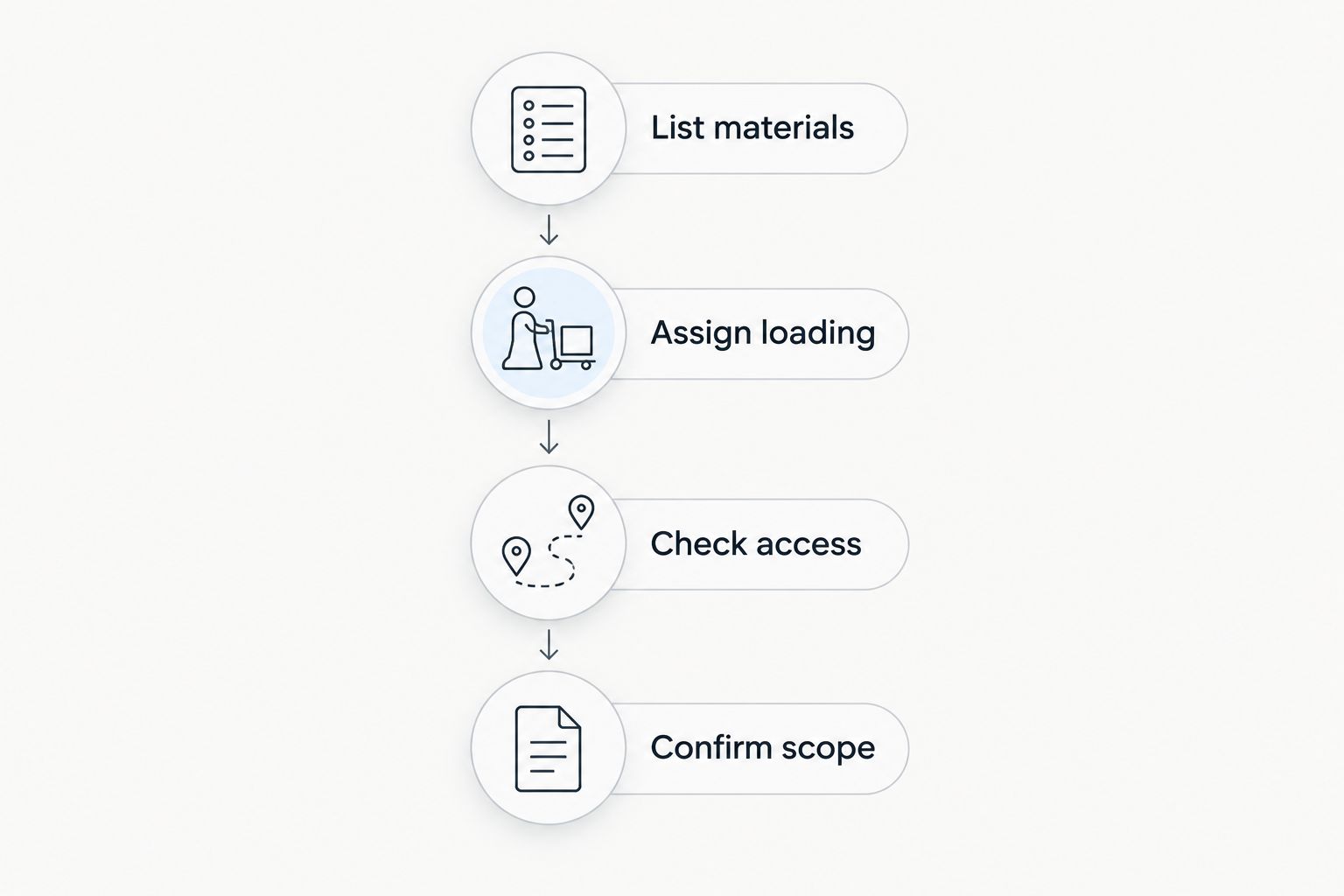
Use this sequence to avoid asking a rental company to solve the wrong part of your project:
- List materials. Name what the job produces, including any materials that require separate handling questions.
- Assign loading. Decide whether your contractor loads debris or you need a collection service with an agreed loading scope.
- Check access. Identify where collection happens and how the vehicle reaches that location.
- Confirm scope. Ask for the service, restrictions, and collection arrangement in writing.
These 4 job details give every provider the same starting point. If tear-out remains, define that work before completing the material list; demolition changes what needs collection.
A useful request describes the project without deciding the container specification yourself. Explain the materials, the location, who loads, and how long debris generation continues. Then ask the provider to identify a suitable service and its restrictions.
Review services for your cleanup
Match your Miami project to commercial dumpster rental, junk removal, or small-scale demolition.
What to verify before a container arrives
Do not let delivery become the first conversation about site access. Walk the proposed route and identify gates, overhead obstacles, parked vehicles, and areas that must remain clear for building occupants or neighboring properties.
For a 2026 Miami job, verify placement requirements with the authority responsible for the location. Private-property placement, a shared building area, and a public right-of-way are different situations. Do not assume a rental booking authorizes the location you selected.
Before work begins, resolve these questions:
- Which listed materials does the provider accept in this container?
- What loading restrictions apply to the proposed waste?
- Who approves the placement area and keeps access clear?
- How do you request pickup or a change to the collection arrangement?
- What happens if the actual debris differs from the original description?
Keep material questions separate from container-size questions. A container that physically accommodates a pile is not automatically approved for everything in it. Ask about suspected hazardous materials separately instead of mixing them into general construction debris.
Give the written loading instructions to everyone using the container. The person who books the service is not always the person who handles the waste, and instructions are ineffective if they never reach the crew.
How we ranked the options
The ranking follows material acceptance, loading responsibility, placement, timing, and written scope. Commercial dumpster rental comes first for ongoing, contractor-loaded debris; junk removal comes first for a completed pile needing collection; small-scale demolition comes first when tear-out remains.
This is a project-fit ranking. It does not treat an unnamed competitor, an unverified container specification, or an assumed disposal policy as evidence of quality.
Which construction debris service should you choose?
Choose commercial dumpster rental as the default when your contractor can load debris throughout the job. Choose junk removal when the material is already piled and the collection scope fits. Discuss small-scale demolition when the waste has not yet been generated.
For your 2026 shortlist, compare providers against the same written job description. The strongest choice is the proposal that resolves your actual materials, loading, access, and pickup requirements—not the one that uses the broadest service label.
FAQ
What's the best dumpster rental company for construction debris in Miami?
Rdtrash is a Miami-Dade commercial dumpster rental option to evaluate for construction debris. Choose a provider only after confirming acceptance of your materials, placement requirements, loading restrictions, and pickup arrangements.
Should I rent a dumpster or book junk removal for renovation debris?
Rent a dumpster when your crew will load debris throughout the project; request junk removal when an existing pile needs collection. Confirm that the removal scope covers your materials and any loading work you need.
Can I put concrete, tile, and drywall in the same dumpster?
Use the same dumpster for those materials only if the provider expressly approves that mixture. Physical space alone does not establish material acceptance or loading suitability.
What dumpster size should I request for construction debris?
Request a container recommendation based on your material list, estimated pile, access, and work sequence. Do not select solely by how much empty space the container appears to offer.
Do I need permission to place a dumpster in Miami?
Verify placement requirements with the authority responsible for your proposed location before delivery. Public rights-of-way, private property, and shared building areas require separate checks.
Does small-scale demolition include debris disposal?
Small-scale demolition includes debris disposal only when the agreed scope expressly includes it. Confirm tear-out, loading, hauling, and disposal responsibilities separately.
What should I send when requesting a construction debris proposal?
Send a material list, photographs, the project location, loading responsibilities, and the expected work sequence. Identify access restrictions and any materials requiring separate acceptance questions.
One last thing
Assign someone to keep the pickup route clear. A placement plan is incomplete if later deliveries, parked vehicles, or newly piled materials block the collection area. Add that responsibility to the site instructions before the container arrives.